Brand protection
Ultimate Audit Checklist: Protecting Your Brand from Domain Squatters and Social Impostors
Seven practical steps to find identity gaps, secure the accounts that matter, and prepare a measured response when someone imitates your brand.
Last updated
An impersonator does not need to own your primary domain to confuse customers. A similar social profile, an unofficial support channel, or an expired secondary address can create an opening. A brand audit helps you identify those gaps and decide which deserve action.
The objective is a maintained inventory and a credible response process. You cannot reserve every possible spelling or eliminate impersonation. You can make official destinations easier to verify, reduce avoidable account loss, and prepare evidence before an incident becomes urgent.
Step 1: Inventory the identities you already use
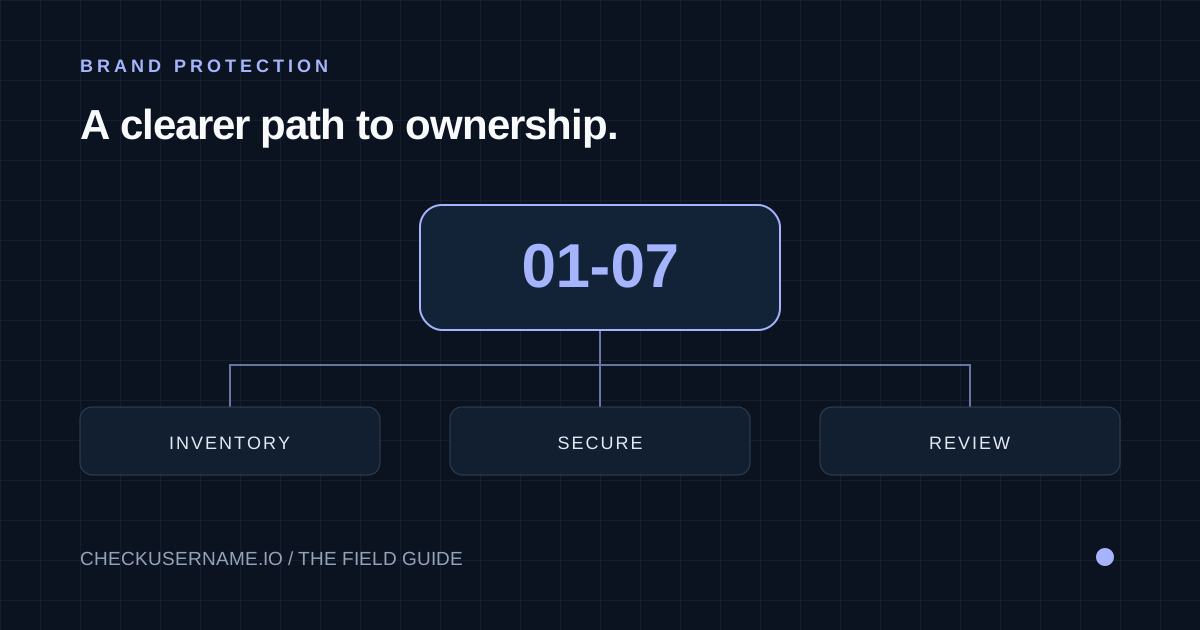
List the primary website, secondary domains, social accounts, developer organizations, package namespaces, community spaces, and support addresses. Include assets created for old campaigns or discontinued products. Forgotten accounts can still appear in search and confuse people looking for help.
Record exact URLs rather than display names alone. For every asset, identify the owner, recovery contact, billing owner, renewal date where relevant, and business purpose. Mark whether ownership has been confirmed by logging in or only inferred from a public page.
| Asset | Evidence to keep | Maintenance owner |
|---|---|---|
| Primary domain | Registrar record and renewal details | Domain administrator |
| Social account | Exact handle and account access confirmation | Channel owner |
| Developer organization | Organization URL and administrator list | Engineering owner |
| Community space | Server or group identity and official invite links | Community owner |
| Package or image | Exact registry coordinate and release access | Release maintainer |
Use the brand protection playbook to prioritize essential, useful, and optional assets. This keeps the audit focused on realistic customer and operational needs.
Step 2: Recheck the names customers are likely to try
Run the canonical brand spelling through the username and domain checker. Investigate obvious alternatives such as a common misspelling, a shortened name, or a support-related variation when there is a credible risk of confusion. Check the destinations where your audience actually interacts with the business.
Record results as available, occupied, manual verification required, invalid, or inconclusive according to the evidence you have. An occupied name is not automatically an impersonator. It could belong to an unrelated person or legitimate business with its own history.
CheckUsername.io includes manual profile links, and some platform entries address a particular namespace rather than every identity on that service. A Discord invite link, for example, is not a check of every Discord username or server name. Investigate community assets inside the platform before drawing conclusions.
Step 3: Secure a focused set of domains
Confirm your primary domain's registration and renewal details directly with its registrar. If selected defensive addresses are relevant, evaluate their cost and intended use. You might redirect a common alternative to the primary site, but owning many domains without maintaining them can create a new expiration problem.
Use organization-controlled registrant and recovery details. Review supported transfer protection, domain locks, multifactor authentication, and renewal reminders. A registrar should provide a recovery process your team understands before you need it.
Investigate a domain's registration state with WHOIS and RDAP, but do not mistake missing public contact details for suspicious ownership. Registration data can be redacted. A domain without an active website may still be registered and legitimately held.
Step 4: Verify social, chat, and developer ownership
Log in to essential social accounts and review administrators, connected applications, and recovery contacts. Remove obsolete access through each platform's supported process. If an agency manages a channel, document how the business retains ownership and what happens when the contract ends.
For community spaces, inspect the actual server or group ownership, administrator roles, public directory entries, and invite destinations. Link official invitations from a maintained page on your website. Do not rely on a screenshot or display name as proof that a community belongs to you.
For software projects, review organizations, npm scopes, PyPI projects, and container repositories separately. The developer namespace checklist explains why securing an account handle does not establish control of every installable artifact.
Step 5: Test recovery and strengthen authentication
Enable the strongest authentication methods supported by each critical provider and appropriate for your team. Keep recovery codes in an approved secure location, and document who can authorize recovery. Avoid making a single person's private email or phone the only way back into a business-critical account.
Check whether a second appropriate administrator can complete routine administration without sharing a password. Review publishing tokens, third-party app access, and stale sessions. Limit privileges to the work people need and revisit them during onboarding and offboarding.
Also inspect your email dependency chain. If registrar recovery depends on an address hosted on the same domain, understand how you would recover during a domain or mail outage. A documented alternative recovery path can prevent a manageable incident from becoming circular.
Step 6: Publish an authoritative map of official accounts
Create a clear place on your website that links to your official social profiles, developer organizations, and community spaces. Keep those links current. Where useful, link profiles back to your primary domain so visitors can follow a consistent trail.
Explain your real support process in plain language. Tell customers where to request help and how to verify a payment or account request. Use practices your team can uphold rather than broad promises that might contradict a legitimate workflow later.
A claimed handle reduces one form of ambiguity. It does not prevent lookalike names, stolen credentials, copied logos, or malicious messages from other accounts.
Step 7: Prepare monitoring and an evidence-led response
Assign an owner and review cadence appropriate to your exposure. Repeat critical checks before launches, after staffing changes, and when customer reports suggest confusion. CheckUsername.io provides point-in-time searches; this checklist does not imply that the product runs continuous impersonation monitoring or sends alerts.
If you find a suspicious identity, preserve the exact URL, timestamps, screenshots, and the conduct causing confusion. Use the platform's official reporting process and protect affected customers through your established channels. Do not assume that a similar name alone proves a policy violation.
For domains, WIPO's dispute resources explain available procedures for applicable registrations. Country-code registries may use their own processes; Register.si publishes its .si dispute information. The correct route depends on the extension, facts, and claimed rights. Qualified advice can help assess a contested case.
Frequently asked questions
Does buying a domain give me rights to the social handle?
No. Domain ownership, platform usernames, and trademark rights are separate. A service evaluates username requests and complaints under its own rules.
Should I contact the owner of a similar account?
First establish the facts and the nature of any conflict. Use official platform channels for suspected abuse. If you consider a legitimate acquisition, evaluate the platform's transfer rules and the identity of the counterparty carefully.
Can I delete my search history after an audit?
Yes, local data controls are available through the privacy policy. Clearing history does not necessarily clear saved names, cached results, or records already held by external providers. See the privacy architecture guide.
Turn the checklist into a maintained routine
An effective audit ends with named owners, verified access, sensible renewals, and a response process people can find. Start with the identities you already use, then investigate the highest-value gaps. Review your brand's domains and handles and record the next action for each essential asset.