Domain strategy
Beyond .com: Navigating .ai, .io, .dev, and .net for Modern Tech Products
Choose an extension for your audience and ownership budget. Compare familiar and technical suffixes without confusing branding appeal with search rankings.
Last updated
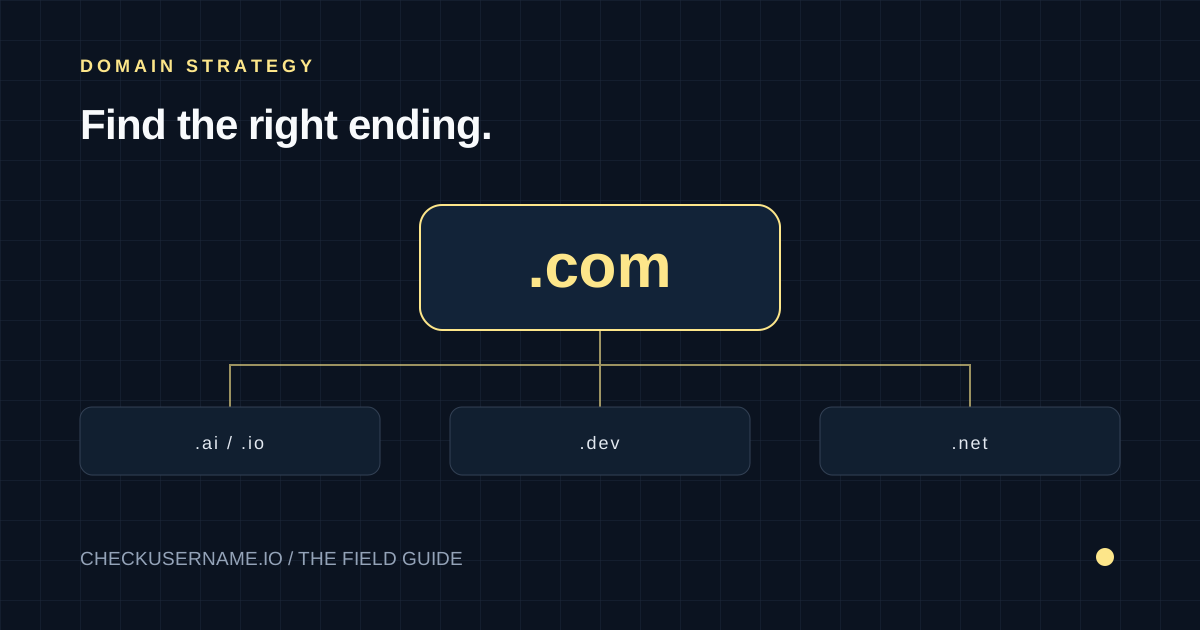
The extension is a small part of a domain name, but it affects how you introduce the product, what customers assume about it, and how much the address costs to maintain. A short .ai name and a descriptive .com address can both be reasonable choices for a technology business.
The useful question is which complete address best serves your audience over time. Compare recognition, product fit, operating requirements, and total ownership cost before allowing availability or a trend to decide for you.
Understand what kind of extension you are choosing
A top-level domain, or TLD, is the final label in an address such as example.com. Generic TLDs include .com, .net, and .dev. Country-code TLDs are associated with countries or territories, even when businesses elsewhere adopt the letters for another meaning.
The IANA record for .ai identifies Anguilla and its government as the manager. The IANA record for .io identifies its country-code classification and manager. Their use by AI and developer companies does not change that underlying classification.
Some extensions marketed as modern alternatives are well established. .net is not a newly launched suffix, and an existing country-code domain becoming fashionable is different from a new TLD entering the root zone. That distinction matters when you assess registry policy and future availability claims.
Compare the practical tradeoffs
| Extension | Classification | Potential fit | What to investigate |
|---|---|---|---|
.com | Generic | Broad businesses and consumer products | Exact-name availability and acquisition cost |
.ai | Country-code: Anguilla | Products with a meaningful AI focus | Registration period and renewal terms |
.io | Country-code | Tools for a technical audience | Registry policy, costs, and audience familiarity |
.dev | Generic | Developer tools, documentation, portfolios | HTTPS readiness from the first visit |
.net | Generic | Infrastructure and network-oriented identities | Confusion with the same name on other suffixes |
These are audience and branding considerations, not eligibility guarantees or a ranking of extensions. Confirm the policies and prices for your specific candidate with a registrar before paying.
When .com or .net fits the product
Consider .com when you want an address that does not tie the company to one technical category. A product can change its implementation, buyer, or feature set while keeping a broadly positioned name. Check what already exists on similar domains so customers do not land on an unrelated business.
.net can work for a network, infrastructure company, or community with a name that sounds natural in full. Do not choose it solely because the corresponding .com is taken. First investigate whether the other identity creates a meaningful conflict and whether spoken referrals will routinely go to the wrong site.
For either suffix, a clear alternative name may be a better operational choice than a costly acquisition. Compare several complete addresses instead of treating one unavailable word as the end of the naming process.
When .ai or .io adds useful context
An .ai address can communicate a product's focus to people who already associate those letters with artificial intelligence. Make sure that association remains accurate if the product evolves. If AI is a minor implementation detail, tying the entire company name to it may create unnecessary constraints.
An .io address can feel natural in developer communities that associate IO with input/output. Test the same address with buyers outside that community. A suffix familiar to engineers may still need explanation in procurement, spoken referrals, or general consumer marketing.
Country-code policies and management can evolve. Review the registry's current terms rather than assuming every extension follows identical transfer, renewal, and dispute rules. Avoid basing a migration on speculation about future policy changes.
.dev requires HTTPS planning
Google Registry's .dev documentation explains that the extension is on the HSTS preload list. Browsers that enforce this list require HTTPS for .dev websites. You need a working certificate and an HTTPS-capable hosting setup before expecting those visitors to reach the site.
This is particularly relevant for teams used to testing a public domain with plain HTTP before configuring certificates. Prepare certificate issuance, redirects, and deployment together. The suffix does not automatically secure application code, access control, or every service under the domain.
A .dev address can be a clear fit for documentation and tools. Choose it because that identity fits your audience and your hosting is ready, not because the letters imply that every security requirement is handled for you.
An extension alone does not guarantee SEO results
Google's guidance on new TLDs explains that new generic suffixes do not receive an inherent search advantage from their extension. Useful content, crawlable pages, and the broader quality of the website still matter.
Geographic meaning is a separate consideration. Google's international site documentation describes country targeting and exceptions for some country-code domains. Do not assume all ccTLDs have identical treatment. The .si branding guide discusses why a new marketing interpretation does not erase the extension's national identity.
Keep one primary domain and a consistent internal linking plan. If you buy secondary domains, give each a purpose rather than publishing duplicate copies of your entire website.
Compare renewal costs and verify in bulk
For each candidate, record the purchase price, renewal price, required registration period, premium status, transfer costs, and available recovery support. A low introductory price may be less important than predictable renewals when the address becomes central to your product.
Use bulk domain search to investigate a shortlist of full names together. Keep the same core spelling across several extensions so the comparison is meaningful, then use domain search to explore alternatives. The tools provide point-in-time research; the registrar confirms registration and final pricing.
Check the corresponding handles before committing. The brand protection playbook shows how to combine domain research with your essential social and developer identities.
What the 2026 new gTLD round means
ICANN's 2026 program concerns applications to operate new extensions, a different process from buying an individual domain. Its official application-window announcement set the window from April 30 through August 12, 2026. At this article's October 24 publication, those dates are past.
An application is not an approval or a public registration launch. Evaluation, contracting, technical delegation, and the registry's launch policies are separate milestones. Monitor ICANN's new gTLD program and the eventual operator's announcements before treating a proposed extension as something your startup can register. Build today's naming plan around verified options.
Frequently asked questions
Is .ai better than .com for an AI company?
It can fit the positioning, but neither suffix automatically wins. Test the complete name, customer understanding, conflicts, and multi-year costs.
Does .dev include hosting or a certificate?
The domain registration alone does not supply your deployment. Arrange HTTPS-capable hosting and a valid certificate through the services you choose.
Should I buy every extension of my brand?
Usually prioritize your primary address and a limited set of meaningful defensive registrations. Budget for renewals and maintenance rather than collecting extensions without a clear purpose.
Pick the complete address, not just the suffix
Choose a domain that customers can remember, your team can maintain, and your product can grow into. Compare the name across domains and handles, verify the registrar's terms, and make the extension one considered part of your identity.